This blog is a companion to the book, a living book of sorts. The world of grants and crowdfunding never sits still. As we continue to explore and learn, we will share our discoveries in new blog entries that, one day, will augment the next edition of the book. So bookmark this site www.thesciencegrant.com
Keep your book URLs updated and don’t be afraid to write the updated ones in the book itself. We have asked our publisher, World Scientific – the publisher for Nobel literature – to leave ample margins for you to write in. Whenever any URL given in the book changes or disappears, we will inform you and provide a new address as soon as we locate their new location. Alternatively, if the page is still available in the INTERNET ARCHIVES, we will point to it there. Writing in a book is not only making it yours, it also makes it more memorable and actionable. If you are still in doubt, read the paper “The pen is mightier than the keyboard: advantages of longhand over laptop note taking”.
If you landed on this page and do not have the book – here is what it contains:
Prepare for a grant panel interview with realistic questions, hostile challenges, back-up slides and post-interview analysis using interactive AI.
How Merlin and AI prepare a young knight for difficult grant interview questions
King Arthur set the date for when the young knights will present their proposals to be granted the privilege of freeing the princess from the evil Lord’s castle. The King also assembled a panel to question them. He asked his seneschal, Gaius, the man with the King’s money; Guinevere, the King’s wife and advisor, also an expert in matters of the heart and princesses; and finally Sir Gawain, the King’s nephew, a skilled knight and formidable warrior. If they are not convinced that your proposal is the one that has the best chance to deliver the princess, it will take you much longer to have a seat at the Round Table.
The panel shows a diversity of functions and skills
You are not afraid of presenting your project. You have prepared the drawings, and you have rehearsed your speech multiple times with your manservant. What you fear are their questions. You are young, not good in politics, just a tactician. There is still so much you don’t know. You need a little magic. You will ask Merlin to help you prepare for their questions. Luckily, Merlin grants your wish and grants you an interview; nothing formal, he says, just a little chat.
Merlin’s little Chat: anticipating grant interview questions
Merlin’s little Chat: anticipating grant interview questions
“So young knight, you will appear in front of the grant panel for an interview and you want to know what are the usual questions asked by the panel?” The knight nods. “I will grant you your wish, but the panel is not just evaluating the quality of your answers. It is evaluating you and how you respond under pressure. It is evaluating your grace and your ability to listen and to think on your feet. But, since it is your wish, here are your questions.”
He waves his magic wand, and in seconds, the knight finds himself with a long scroll in his hands. Unfolding it, he counts nearly one hundred generic questions grouped in 11 categories. The brave knight is stunned: there are so many questions to prepare. Undaunted, he reads the questions and mentally crosses out those not relevant. There are still quite a few left to tackle. Some are answered in a few words, some require additional planning and drawing.
“These questions will stress-test your budget”, says Merlin, “and ask you if you can free the princess with less silver and gold. They will question your unique competitive strength, ask what makes yours the best approach, challenge your methods, dispute your impact. Are you ready?” “What do you mean by challenge your methods?” you ask. “Well,” Merlin responds, “look at the third question on your scroll: ‘Do you have sufficient experience in the methods you propose to use to free the princess?’ Now, imagine Sir Gawain asks it this way, “My young knight, you claim you know about a good method to free the princess, but have given no evidence you have ever tried that method. You are either foolish or foolhardy. What makes you so confident this mission is feasible?” The young knight shivers. Clearly, the scroll with generic predictable questions is not enough. He needs to prepare specific unpredictable questions, even hostile ones. But Merlin is one step ahead. “I know, you have no one to interact with, and no one to give you immediate feedback, so…”
He waves his magic wand and a large book appears. The book is alive. “This book will ask specific questions”, says Merlin. “You answer them. It evaluates your responses and helps you answer them better. It will not be afraid to argue with you, so, be brave and learn! I have given the book a name: Claude, after a future nephew who will be a real wizard in his time. When you open Claude for the first time, just say hello.”
Merlin’s live book to prepare questions and evaluate answers
Merlin’s Book: The Answerable Knight
The young knight thanks Merlin profusely and leaves with the book. Once home, he puts it on his lap and opens it. Its pages are blank. He says “Hello”. The book on his lap warms up. Words appear and disappear: “Picturing, figuring,” then a message: “Welcome to the LiveBook: ‘The Answerable Knight’.” He reads the introduction, and two notes. The first note says, ‘I can follow your own language. If you prefer to continue in Saxon, speak Saxon. But you can speak in French, Spanish or Mandarin, and even switch between languages at any time.’
The second note says, do not tell me secrets. For example, don’t say you want to attack Tintagel Castle, not even a castle on a rocky peninsula in Cornwall as the list is narrow. Remove every detail which, combined with others, would make discovering your secrets easy. You have alternatives: use an already-public proposal, construct a substantially generalized project, or enter only the minimum information required for a particular exercise. But in all cases, follow your institutional AI and data-protection policy!
The book then asks, “What do you want me to do? Find the type of questions your talk could trigger, analyse where you went wrong in previous questioning sessions, or simply learn more about the best techniques for receiving and answering questions.”
The knight explains his mission and his need to prepare for a grant interview at King Arthur’s castle, and then asks, “Give me questions that Gaius or Guinevere might ask.” The book immediately complies.
“Hi, I’m Gaius. I don’t mean to — I know this may already be in your drawings — but I was looking at the provisions column, the silver for men-at-arms and horses, and I couldn’t quite square it with the timeline you gave, the six weeks — is that six weeks all told, or six weeks just to reach the castle, because if it’s the latter then the number seems…”
“Ouch,” the knight says. “That looks like two questions in one statement. How do I rephrase and answer multiple questions like that? Can you ask me another question?”
“Hi, I’m Guinevere. As the Queen, and as one who has watched more than one match arranged for land rather than love, I ask this directly:What happens to the princess’s own wishes in this plan? You’ve told us how you’ll take the castle. You haven’t told us what you’ll do if she doesn’t want to be freed.“
“Ouch again,” he says. “The Queen is pulling rank on me, and probing right into my weak spot. My plan was to extract her, not ask for her consent!” He has no answer, but he remains silent for too long, and the book tells him the Queen is getting impatient and wants an answer now. He rushes to answer. “Of course, the princess will come. I’ll make sure of that”, he says boastfully. The Queen responds, “You shall forthwith and henceforth address me as ‘Your Majesty’, and you have not answered my question except with vague words that indicate you did not think things through.” The knight is distraught, but the book now explains what he did wrong: lack of basic courtesy, zero-basis evidence on claim, and no rephrasing of the question to ensure it is fully understood. He gathers his spirits, rethinks his answer, and tells the Queen, “Yes, your majesty. What would I do if the princess refuses to leave, I believe is your question.” “That it is”, says the Queen. “Your Majesty, the King’s express wish is for the princess to be freed, with or against her will. I would take a gentler approach and reach the princess through her handmaid first, to find out whether the princess is receptive to the plan. If she is not, I would ask her what would make my proposal more attractive, and give her a deadline to accept my counteroffer.” The book acknowledges the progress in structure and delivery, but still flags the unresolved ethical issue. It then asks “Shall we move to the question of the treasurer Gaius?” “Claude, let’s stop here for now.” “You’re leaving already?” Claude asks, “I have many more questions for you, my knight.” “I know,” he replies. “But night is near”; to which Claude responds “Good night, good knight.” The book grows cold, and the contented knight falls asleep, knowing that real help is at hand.
Back to the Future – The Answerable Scientist LiveBook
“LiveBook” is a method and structural model described by Mihailo Zoin that turns static information into interactive one. I adapted that model to create The Answerable Scientist substantially redesigning its instructions, tools and knowledge base around my own scientific-communication material. The Answerable Scientist runs on personal computers as a project inside Claude. If you are interested in this LiveBook, contact me at Scientific Reach, and if you want to transform your document into a LiveBook, acquire Mihailo Zoin’s innovative method. Don’t hesitate to spend time improving your own document while making it interactive. That is time well spent! Claude.ai has been chosen because of its ability to generate clickable, inline, in-chat SVG that triggers conversation on click. The inline-rendering surface can carry JavaScript that runs in the browser. For example, when you practice answering questions, clicking on one of the questions in a question panel starts a string of timers: the first one times your reading, and when done, passes the relay to the second eight-second timer. If you haven’t started typing when it hits zero, a line appears noting that the silence is being felt by the room. You can still answer after the 8 seconds, but the pressure is real!
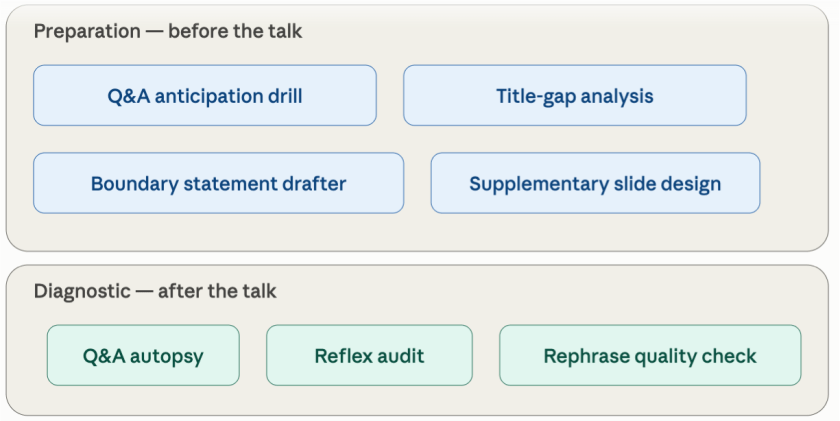
Eight knowledge nodes, each with its associated knowledge base accessed when clicked.Seven tools to prepare questions, answer them, evaluate them and set up boundaries beyond which they should not be answered.
Answerable to a Grant Panel
The grant panel has already read your grant application as well as its evaluation by several reviewers. It wants you to defend your choices, and clarify the concerns that remain. Behind each question is a concern. The effective answers are those that address them. When the underlying concern is unclear, ask clarifying questions. They will help focus your answer. For example, “Your Majesty, are you principally concerned about the ethical issue of freeing a princess without her consent or about the effect of her refusal on feasibility?” Sometimes, you do not know the answer, and it is fine to say you don’t know ‘yet’, and then propose a plan to find out. Grant panels understand uncertainty, but they will not accept evasive answers.
The scroll (a question in ChatGPT) helps you anticipate probable questions. The LiveBook does something more valuable: it questions your answers, exposes their weaknesses, and makes you try again. Merlin’s help is not magical, it is practical. He is not magically revealing the questions the knight will be asked, he is preparing the knight for whatever comes.
With practice, using this tool, you will gain human skills , skills you will use well beyond your grant interview: listening skills, rephrasing skills, hospitable skills to keep you gracious in the face of adversity. But also, analytical skills.
We all have Kings we are answerable to, before the grant, during the grant, and after the grant. Questions are a fact of life, not just scientific questions. Let’s learn how to answer.
Before Choosing Your Methods, Understand the Mission
Wikipedia CC BY-SA 2.0 Caerphilly Castle Wales Author: David
King Arthur has just knighted you. Congratulations.
During the celebration banquet, the king gives you your first mission. A princess is being held captive in the dungeon of a classic medieval castle, complete with a moat, drawbridge and guards checking everyone and everything that enters. You are to free her and bring her safely back to Arthur’s court.
The king even gives your project a grant-worthy title:
PRINCESS: Protected Recovery via Infiltration, Negotiation, Confrontation, Extraction, Security and Safe-return.
Of course, being a smart knight, you do not take your new sword and rush towards the castle. You get on your horse, travel to the site and inspect the surroundings. Half a mile away stands a steep rocky hill mostly inhabited by grazing goats. From its summit, you study the castle and consider how you might enter it.
The goats offer no advice. This is probably just as well.
You have an objective, several possible approaches, many available methods, limited manpower and a fixed period in which to complete the mission. You also have a funder who expects more than an account of how enthusiastically you swung your sword.
Welcome to grant vocabulary.
Begin with the mission, not the labels
Why does Arthur want the princess rescued? It is the castle version of the questions every project proposal should answer: What are you trying to do, why does it matter, what is new, what are the risks, and how will you recognize success?
The rescue is not his ultimate goal. He hopes the princess will marry one of his sons, creating an alliance that will increase the size, security and influence of his kingdom.
The broad goal is therefore to strengthen the kingdom through political alliances.
The expected outcome is the formation of an alliance through marriage.
The knight’s bounded objective is to free the princess and bring her safely to Arthur’s court.
That distinction matters. The knight can control how the rescue is attempted. He cannot guarantee that the princess will marry Arthur’s son, that the two kingdoms will honour the alliance or that the alliance will produce lasting political advantages. Those changes depend on people and events beyond the immediate project.
A grant applicant faces the same problem. You can promise to conduct the research and produce credible results. You may be able to encourage their adoption. You cannot command society, policymakers, clinicians or industry to use them.
Promise what the project can deliver. Explain what that delivery could enable.
Stand on the hill before choosing your tools
From the hill, the obvious approach is a direct assault. Draw your sword, cross the drawbridge, overpower the guards and fight your way to the dungeon. Let us call this the Schwarzenegger approach.
It is direct and uses familiar methods: recruit soldiers, build ladders, break through the gate and fight. Its feasibility may be reasonable if Arthur provides an army. Its financial and human costs are high. So are the risks. The princess may be harmed, the castle may be destroyed and the future alliance may be weakened by the inconvenient slaughter of its future members.
Perhaps technology can bypass the guards. Leonardo da Vinci has published promising drawings of flying machines. You could build one, launch it from the nearby hill and land inside the castle. This is the Leonardo approach.
It is novel and potentially transformative. If it works, Arthur gains both a princess and an air force. Unfortunately, the drawings have not been validated through full-scale implementation. Prototype development, specialist expertise and repeated testing will consume time and money. The risk is very high, although so is the possible additional payoff.
You might instead dig beneath the moat and walls. This is the Monte Cristo approach.
Its methods are conventional: survey, measure, excavate, remove soil, ventilate and reinforce the tunnel. The equipment may be inexpensive, but the labour is not. Digging could take months, and an unexpected layer of rock or an underground watercourse could stop the project. The shovels are cheap. The people holding them are not.
You could disguise yourself as a merchant, servant or guard and pass through the gate without being recognized as a threat. This is the Robin Hood approach.
The associated methods include observing traffic, studying guard changes, acquiring a disguise, forging papers, concealing tools and mapping an escape route. The financial cost is low and the manpower modest, but feasibility depends on the quality of your intelligence. One suspicious guard could end the mission.
Finally, you could persuade the captor to release the princess. This is the Kissinger approach.
You would identify the decision-maker, investigate the captor’s interests, establish contact, offer an exchange and negotiate verifiable terms. Physical risk may be low, but political risk remains. Negotiation also has an uncertain duration because progress depends on someone outside your project team.
All five approaches pursue the same objective. They differ in cost, time, manpower, feasibility, risk and wider consequences. Selecting among them means balancing ambition against feasibility, not automatically choosing either the safest or the most spectacular route.
That is why an approach matters.
An approach is not a collection of familiar methods
Applicants frequently choose an approach by starting with methods they already know.
They own a shovel, so they propose a tunnel. They have a sword, so they prepare an assault. They have used RNA sequencing for ten years, so RNA sequencing appears in the next proposal before they have established that it is the best way to answer the new research question.
Familiarity increases feasibility. It does not establish merit.
The label of an approach can be short: assault, flight, tunnelling, infiltration or negotiation. Its justification cannot. The applicant must explain why that strategic route is suitable for the objective, preferable to credible alternatives and achievable with the proposed resources.
The methods are the procedures used to implement it. Under the Robin Hood approach, surveillance, disguise and document forgery are methods. Under the Monte Cristo approach, geological surveying, excavation and tunnel reinforcement are methods.
A novel method may improve a conventional approach: a faster drill makes tunnelling more efficient. A novel approach may use conventional methods: negotiation can combine ordinary correspondence, interviews and bargaining. Both approach and methods may be novel, as with Leonardo’s flying machine. Or neither may be novel, as with swords and ladders.
Do not confuse familiarity with merit—or novelty with merit. Reviewers want an approach that is justified, feasible and capable of producing valuable results.
Build decision points into the mission
A work plan is not merely a calendar showing that tunnelling begins in Month 1 and ends in Month 12. It should help the team decide whether tunnelling remains sensible.
Suppose the Monte Cristo team establishes the following milestone:
By the end of Month 3, complete a ten-metre pilot tunnel and confirm that excavation can proceed at no less than two metres per week without encountering unstable rock or significant groundwater.
That milestone is specific and verifiable. More importantly, it supports a decision.
If the excavation rate is adequate, continue. If unstable rock is found, consider additional reinforcement and calculate whether the work can still finish within the grant period. If groundwater makes the tunnel unworkable, stop digging and activate the Robin Hood contingency plan.
A missed milestone should not simply produce a red box in a progress report. It should trigger thought. It may reveal that a risk has materialized and that the team must identify, assess and manage it before deciding whether to continue, modify or abandon the approach.
The same principle applies to Leonardo. A milestone should not read, “Flying-machine prototype completed.” Completion proves activity, not performance. A useful milestone might specify the load the prototype must carry, the distance it must travel and the landing accuracy it must achieve before a full-scale rescue attempt is authorized.
Milestones can mark progress, test assumptions, open the next phase or force a choice among alternatives. In some funding instruments, they can operate as formal go/no-go criteria. In others, they are control points used to identify problems and initiate corrective action. Their contractual consequences differ, but their intellectual purpose is similar: they prevent hope from becoming the project-management system.
Plan B also deserves more than a ceremonial sentence at the end of the proposal. State what failure or change will activate it. Identify the time, money and people it will require. A contingency that becomes available only after the grant period has ended is not a contingency. It is an obituary.
Follow the project from work to change
Once the approach has been chosen, the mission generates several kinds of things.
Tasks or activities are the work performed: observe the guards, prepare the disguise, enter the castle, locate the dungeon and organize the escape.
Deliverables are inspectable items that may be formally submitted under the funding agreement: a reconnaissance report, a castle map, a risk register or an extraction plan. A deliverable may result from one task, several tasks or an entire work package.
Milestones are verifiable control or decision points: the disguise passes an independent inspection; a safe route to the dungeon is confirmed; the team demonstrates that extraction can occur before the guards complete their circuit.
Results are generated through the project: intelligence about the castle, a validated infiltration procedure and, if the mission succeeds, the safe recovery of the princess.
Outcomes are changes that follow when relevant actors use or respond to those results: the princess reaches Arthur’s court and negotiations establish the intended alliance.
Impact is the wider, longer-term effect: the kingdoms become more secure, prosperous or influential.
These concepts are related, but they do not form a perfectly mechanical chain. A milestone is not simply the product after a deliverable, and a deliverable does not automatically create an outcome. They answer different questions:
What will you do? What will you produce? How will you know whether progress is adequate? What will change if the project succeeds? Why should anyone care?
The mission stays; the terminology travels
The castle does not change when the proposal crosses the Atlantic. Its vocabulary does.
In a typical NIH research-project application, safely recovering the princess might be framed as a Specific Aim. I have discussed elsewhere how to formulate effective Specific Aims. Under the current NIH Simplified Peer Review Framework, the importance of the alliance would contribute to Importance of the Research, while the strategy, methods, controls, risks and alternatives would fall broadly under Approach, evaluated within Rigor and Feasibility.
NIH’s Overall Impact is something different again. It is the reviewers’ prospective judgment of the likelihood that the proposed project will exert a sustained, powerful influence on the relevant field. It is not the societal impact measured years after the rescue.
In a Horizon Europe proposal, the work would be organized through objectives, methodology, work packages, tasks, deliverables and milestones.The project would generate results. Dissemination, exploitation and communication measures would help relevant groups use those results, contributing to expected outcomes and, eventually, wider scientific, economic or societal impacts.
The underlying mission remains recognizable. The labels, boundaries and contractual consequences do not always travel.
Therefore, never rely entirely on a generic glossary—not even this one. Read the call, application template, evaluation criteria and grant agreement. When a funder defines a term, its definition outranks the ordinary dictionary and your preferred usage.
Understand the castle before naming its parts
Grant vocabulary matters because it exposes project logic.
If an applicant cannot distinguish the objective from the hoped-for impact, the proposal may promise changes the project cannot control. If the approach is merely a list of familiar methods, alternatives may never have been considered. If milestones record only completed activities, the team loses opportunities to test assumptions and change direction. If the contingency plan has no trigger, budget or remaining time, it exists only to reassure the reviewer.
The words are not the project. They reveal whether the project has been thought through.
So before reaching for your sword, stand on the hill. Look at the objective, the available approaches, the methods each requires, the people and time available, the points at which you may need to change direction and the consequences of success. A clever approach attached to an unprepared team is not yet a credible proposal. Before seeking the grant, determine whether the organization and its researchers are genuinely grant-ready.
Then learn what your funder calls them.
Arthur is not financing a lifelong attempt to rescue the princess. When the grant period ends, he expects the princess—not an encouraging tunnel, a promising prototype or another round of negotiations.
This book was one year in the making. It distills my knowledge of what writing for others means. And the grant applicant definitely writes for others – the grantors, the people who have the power to shape or reshape the applicant’s future – YOUR future.
You can get it now at leanpub.com (pdf version), or on Apple books (if you have a Mac – that version has interactive exercises), and on Amazon (for Kindle or in book form).
While writing this book, I made four fundamental discoveries.
It is so easy for a writer to forget about how little the reader really knows. The knowledge gap between them is often found in “cause-to-result” statements like between “because, since, as,…” and “therefore, hence, as a result”. Things are just so evident to us that we sometimes wrongly believe they are also evident to others. (Chapter on Reader Expectations).
Grammar is not neutral in the way a writer influences the reader. Of course, we know what parts of speech do. Adjectives and adverbs paint efficiently in brightvivid colors. But surely, clauses and subclauses, the structural elements in sentences, play no other role than carrying their word cargo, right? Wrong! Grammar, used appropriately is a powerful persuader.(Chapter on Persuading using grammar)
A scientist, particularly one expected to evaluate other people’s ideas, cannot be bullied with enthusiasm and promises of slam dunks. How then is one to convey simply, honestly, and respectfully one’s ideas to such strict and demanding assessors of an idea’s worth and an investigator’s caliber? Hedge words are the most powerful weapon in a writer’s arsenal (Chapter 6 on reader expectations).
The brain uses neurotransmitters to control memory and attention. Indeed, some of these neurotransmitters are common to memory and attention, which act as twin cousins in both synergistic and antagonistic ways. Controlling attention is also controlling how much the reader remembers. Alas, driven by the aim of trying to impress and get attention by volume more than by quality, a writer often overwhelms both attention and memory, and an overwhelmed reader is an underwhelmed evaluator. (Chapter 1, 3 and 4 on the physiology of memory and attention and the techniques to sustain these core reader resources).
PIs frequently face the problem to decide whether to resubmit or to write a new application. Imagine a game of dice with the following rules: roll a regular dice, you win if you get a six; however, you never get to see the face of the dice when it stops rolling, someone else does. If the dice turned a four or a five, you are asked to toss the dice again. If you turned a four in the first toss, you always lose whatever the second roll of dice turns up. However, if you turned a five in the first toss, someone will toss a coin privately. If it lands on Head, you win regardless of the result of your second dice roll, if it lands on Tail, only rolling a six is a win. Would you roll the dice again, or would you pass on the opportunity and start afresh?
If you knew you had a five, you would resubmit because your chances of winning are much higher. This is often the case if you resubmit early and the review panel has not changed. But sometimes panel members change and the new members mostly view your resubmission as a new application (a new roll of the dice). And if you knew you had a four, no amount of rewriting effort would have helped and you would have submitted a new application.
So, how does one determine whether a four or a five turned up in the first roll of dice?
Reviewer feedback could guide you, but the most critical document to help you determine your chances is the summary in which the session chair captures your grant’s most important problems. So before you start addressing the comments of each reviewer in your resubmission, consider that summary first. Where is the real problem? You may have to read between the lines to find out.
Are you the problem? Investigator is one of the big five evaluation criteria (Innovation, Significance, Approach, INVESTIGATOR, Environment). Do you feel that most comments in all five criteria always point back to you, directly or indirectly: lack of confidence in your ability to manage a complex operation involving many participants and a large budget, lack of confidence in research expertise with no senior PI as collaborator or mentor, lack of confidence in your choice of collaborators (they are your friends – present more by courtesy than by necessity, or they are there by necessity but you have never worked with them in earlier projects or written papers together – so they present a risk). In that case, it may be better to rewrite your application with a better team.
Is significance the problem? To gain significance, you add specific aims which make your project complex given the high variety in methods used or the variety and cost of equipment involved. To gain significance, you rely on too many assumptions; for example: if this is available, and that comes to fruition, and if the other thing happens – the research would have large implications. To gain significance you rely on the most iffy specific aim, the one with no preliminary data or work. Significance is intimately linked to innovation. With little innovation, the significance is low because the next steps, i.e. the opportunities for further research your grant will open, are too limited. It may be better to rewrite a new application with more realistic and better supported aims, or with a greater focus on what happens next.
Is vagueness the problem? The comment “lack of detail” often hides a larger problem which could be remedied, not by more unneeded details, but by details which are more relevant to assess your expertise and project planning skill. “Lack of detail” may indeed reveal that your plan is not worked through. But it may also be that you assumed the reviewers knew much more than they actually did, which made you leave out the justification for the approach or methods. Pity, for it would have shown you understand their strengths and limitations in a technique-rich landscape. You have not deemed necessary to add expert details or references that show you know and care about the known pitfalls of methods, statistics, and data collection. The “I’m-aware-of-that” detail is exactly what the reviewer needs to assess your competency. Finally, vagueness of the research question will inevitably lead to “lack of detail” comments, so clarify and resubmit.
Is lukewarm support from the panel the problem? Again, Do not be fooled by the mildly supportive ho, hum comments intended more to prevent your neurotic breakdown than to compliment you. Your research question may simply not be exciting enough, or is too insignificant. It needs to be looked at again. Write a new application when you have a better idea with greater significance.
The recommendations above are based on episode 63 of “the effort report” podcast by two eminent PIs with extensive panel and submission experience: Elizabeth Matsui and Roger Peng
Grant writers look for the financial health of the grantee because poor financial health means trouble. Does your organization rely solely on grants for their funding, or do they have other means of financing research, such as licensing of patents, national program financing, partnership with industries… In other words, grant writers want to avoid situations where the grant applicant is desperate to get cash to survive, because desperation often results in hurriedness, and hurriedness rarely bears fruit. In a world where all applications are graded with an A+ or an F, only the well-prepared get funded.
Grant writers also look for answers. They should not be the ones to fill the blanks. Sounds familiar? The senior PI, without a solid plan and research objective, may ask junior researchers to conceive one. The design of the plan is then left up to the less-paid unguided research associates under the excuse that preparing a grant provides hands-on experience in grant applications. I have seen that before, and I have looked into the eyes of unprepared junior researchers unable to answer the simplest questions about the grant they prepare without referring to the PI for answers. They get thrown in at the deep-end trying to accomplish the impossible when, in fact, a pilot study, or exploratory research is first needed before moving on to the larger grant they are asked to prepare. And as they reveal their problems to their PI, the PI alters the grant objectives based on his or her new understanding of the problem. The ground keeps shifting. Maybe this is a valid way to conduct research; But it is not a valid way to prepare for a grant. The senior PIs should indeed involve junior researchers in grant preparation, but the research design, the hypotheses, and the research objectives are squarely in the PI’s camp. Sheep do not guide the shepherd.
Crowdfunding is here to stay. I have already spent hundreds of dollars funding different products on indiegogo. These products directly address personal or family needs that the market does not currently address. Crowdfunding is a wonderful way to encourage start-ups 1) by showing that their product ideas are meeting real needs, 2) by funding the development of the first prototype or embodiment of a product idea, and 3) by enabling the collection of early feedback from pioneering users.
However, these regular crowdfunding sites do not cater for science projects and products which are below level 5 on the technology readiness Level (TRL). That nine level scale, created by NASA in the 70’s and then extended to domains outside space exploration, helps with funding decisions. Many funding organizations ask the applicant to peg their project to a readiness level. So it is useful to assess the readiness of your own project BEFORE you target specific science crowdfunding sites. The closer to market the product/project is, the more fundable it becomes, and the less risky it is overall.
The book promoted by this website, mentions several crowdfunding sites: Experiment.com, and walacea.com (now crowd.science).
Sir Alfred Russel Wallace
The funder of Walacea (Natalie Jonk – UK) named her site after the pioneer in crowd funding for science, Sir Alfred Russel Wallace, who funded his independent research on natural selection by selling beetles and other specimens he collected in the East Indies. In a way, Sir Wallace networked extensively, gave talks, and solicited money, but had something to offer in exchange: new knowledge and exotic specimens from abroad.
Similarly, a project fully funded by crowd.science on pesticides and bees offers financial backers the type of scientific fares one would expect from academics: invitation to a lecture on the topic, copies of a book written by the project leader, or a guided walk. But private individual funding is not enough. Roughly a third of the funding for the pesticide and bees project came from wealthy sponsors whose purpose is aligned with the project (friends of the earth, beekeeper associations). So, if you want to fund independent research, make sure you have something to sell – or more politically-stated, “offer” to your funders: tangible things, knowledge, or shared vision. The higher the TRL level, the more palatable your offerings will be.
Roald Hoffman, Winner of the 1981 nobel prize in Chemistry, wrote a enlightening book: THE SAME and NOT THE SAME. Both sides of the photo show the Khmer temple. The same temple?
I thoroughly enjoyed reading it. Roald Hoffman is a renaissance man with an encyclopedic culture and many talents outside of chemistry. But this blog is about the differences between a grant application and a scientific paper. The link with chemistry will become apparent later.
In my earlier “Ins and Outs of Grant Writing” classes, I asked the participants to list out what the differences are. Having no experience in grant writing, they listed out the obvious differences, for example: a paper is about completed research, a grant is about future research; a paper is to get recognition and citations, a grant is to get money; The structure and contents of a paper (mostly the IMRAD structure) are quite different from the structure and contents of a grant which also includes a budget, a schedule, a detailed list of past achievements and grants received.
By the time the class was finished, the list became more comprehensive… but note the ellipsis!
Differences between writing a grant or an article
Grants: pre-significance
– It presents a plan
– It has more justification on the approach / methodology you want to adopt
– It presents alternatives (plan B) to mitigate risk
– It is read and accepted by more lay people, or people with less expertise in your research topic
– It has to show return on investment
– It needs to convince the readers that you are the right person to do this research (why me) and that you will use the money properly in the timeframe of the grant.
=> need to convince the project is feasible.
– It has a large admin overhead
– The visuals to represent flow / process / ideas play a very important role
– resubmission is limited
– Selection is collective (panel)
…
Articles: post-significance
– It presents a report
– It gives greater details
– It is read and accepted by experts in the field
– The why me aspect is less important
– It needs to convince the readers that the conclusions are correct
=> need to convince on conclusions
– Its visuals are more of the type that feature results: tables / graphs
– Resubmission is easy
– Selection is individual (editor)
…
One aspect was missing from that list, one that participants expected to be the same for both grant application and manuscript: the writing style. “The same and not the same” applies here. Roald Hoffman’s book is amazing. His writing style is clear. His sentences are precise, yet with a simpler structure and reduced number of clauses. He bonds with his reader, not chemically, but intellectually, by being clear and accessible, by making sure the jargon is properly explained and illustrated if need be. In his review of the book, Carl Djerassi, published scientist and author but better known as “the father of the pill”, writes “[Hoffman] is the ultimate literary alchemist […] he transforms base facts into golden understanding.” Your writing style should move from the scientific writing style towards the science writing style. Read popular scientific magazines like “the Scientist”, “the American Scientist”, “Scientific American”, or “New Scientist”. Personally, I read articles in “The Scientist”, and “SciTech daily” – daily online magazines covering both life and engineering sciences.
“The same” precision and rigor of science, “Not the same” writing style.
Note: A list of these differences is proposed in an article written by Dr. Robert Porter, in a 2006 article entitled “Why Academics Have a Hard Time Writing Good Grant Proposals”. I do not quite agree with all of his differences – for example, I disagree that a paper is an individual exercise whereas a grant is a collective one. Nowadays, in 2017, more and more papers are a collective effort, especially in fields like Physics. I had forgotten all about Porter’s 2006 paper when I came across episode 57 (October 2017) of the chatty podcast of Dr. Roger Peng and Dr. Elizabeth Matsui – the effort report that mentioned it. They broach the topic of “not all scientific writing is the same” (move straight to minute 53 of the podcast!). When Elizabeth Matsui became interested in the topic in her capacity as a mentor of young PIs having to write their first grant, she realized that her new PIs came to a grant application with expectations that it would be similar to a scientific paper. After all, that is what they were familiar with. So highlighting the differences was essential.
In the IEEE Founders Award Lecture published in The Bridge, 1992, (National Academies press) on Some reflections on innovation and invention, luminary George Heilmeier put in eight simple questions what anyone proposing a project should be able to answer.
“What are you trying to do? Articulate your objectives using absolutely no jargon.
How is it done today, and what are the limits of current practice?
What’s new in your approach and why do you think it will be successful?
Who cares? If you’re successful, what difference will it make?
What are the risks and the payoffs?
How much will it cost?
How long will it take?
What are the midterm and final “exams” to check for success?”
A proposal should be as jargon free as possible, and certainly its objective should be clear to all, experts and non experts. If you absolutely have to use jargon in the title, it must be defined in the abstract. Definitions cannot wait till the reviewer gets inside your grant. Why? Title and abstracts create the first impression. If the proposal presents the objective in a way that the reviewer feels his or her nascent interests are aligned with the proposal, a conformation bias is likely to appear – which of course, plays in your favor. It is difficult to feel good about something you do not understand!
The gap is what answers the second question. Remember that to innovate you extend, or modify what already exists (“done today”, “current practice”). Blue sky research grants exploring the pitch-dark side of research are not for everyone. You need an outstanding track record for those. The grey side is more accessible.
Novelty is expected, often in methods and approach, but with novelty comes risks, and risks are expressed in levels of confidence. That confidence is built over years of experience and a deep understanding of what your abilities are, but not only. The “You” is now plural. “You” are a team.
That you care about your project is a given, but do others care as much as you do? Who are these people? And if they do not know they should care, will you be able to show why they should, in a compelling way? Before you ask other people to get into your shoes, find out whose feet are blistered, feeling pinched, or in daily need of a shoe horn. For that, investigate, not the limitations that are there, but the consequence of these limitations.
Risk is a word rich in meaning. It spells potential trouble, but it also promises great rewards, not just payback, but payoffs – returns on the grant investment. Although it is not becoming to talk hard dollars when one is concerned with genes and quarks, it nevertheless will ultimately translate into hard currency for someone down the line. The economics of research matter to the grantor. If that payoff in dollars is further down that you would like, at least reveal the path that will get there. Build a dissemination plan to ensure long term impact.
Finally, just like students have midterm and final exams, build a solid evaluation plan to make sure you know if you are on track (or not) and meeting your specific aims, on time, but also quantitatively and qualitatively. Good evaluation criteria are hard to come by. Learn from other PIs how they do their formative and summative evaluation plans. And remember that success is not what you say it is, but what others agree it is. So make sure you give them your success evaluation criteria before they create alternative ones you will disagree with. Deciding on these criteria is a team exercise. Involve your grant team. In the process of trying to establish these success criteria, you may discover that some of your specific aims are vague, not measurable, and require rewriting.
Should you ever doubt that risk is an important factor in grant evaluation, read on. I just looked at the reviewer comments for a European grant which missed funding despite an overall score of 87/100. Let me just quote the reviewer comments under evaluation criterion 3 – Quality and Efficiency of the implementation:
“Potential risks in research activities are insufficiently substantiated. The mitigation strategies are only superficially addressed and insufficiently justified.”
To paraphrase, ” you have identified potential risks, but have not described them in detail – thereby indicating you need more awareness on how these virtual risks will take shape during your grant. Consequently, the strategies to lessen or handle these risks are superficial and whether they are the right ones to mitigate these risks is unclear.”
Note that the applicants are not accused of ignoring the risks. They are criticized for not demonstrating they have a clear idea of what these risks are and how to deal with them should the improbable occur.
So let’s learn about risks and the strategies to address them.
The norm ISO 31000:2009 defines risk as the effect of uncertainty on [accomplishing your] objectives. In the case of a grant, uncertainty affects pretty much everything: your budget, your plan A, your choice of a suitable approach and collaborators, etc. Uncertainty’s effect is to make your project deviate from what youexpect will be the normal course of events. Uncertainty introduces deviations around the normal (not a new concept, really) – some which can be compensated for, others which have far reaching and long lasting consequences. Where do these deviations originate from? Unexpected events top the list. Either you did not know such events could happen, or you presumed they would not happen, yet they did, and vice versa, or you minimized their likelihood, or you misjudged their consequences and outcomes.
You, the PI, are the risk owner and manager. Since you are accountable for taking risk, you need to justify the risk you take, within the grant application. But first, you have to identify the sources of risk, evaluate the degree of risk, and establish your risk profile. With your risk profile in place, you are ready to draw a risk-management strategy.
ISO 31000 identifies seven ways to manage risk: one to increase it, one to maintain it, and five to mitigate or cancel it.
Increase the risk exposure when greater risk would have an even greater overall payoff.
Monitor the risk closely without removing it for it has both beneficial and negative aspects.
Decrease the odds of the negative risk by reducing uncertainty.
Dilute the unwanted risk by sharing it.
Change the outcome of events that affect the objectives because they increase task cost, introduce delays in task schedule, lower safety, or worse impact on the environment.
Remove the risk trigger (circumstance, situation, process, environment, practice)
Cancel the activity associated with the unwanted risk or replace that activity with one of lower or no risk.
Read again the book chapter on risks and determine which of these seven ways to treat the many risks summarized page 176 would be the most effective in your context. Context does matter because it favors the occurrence of events. Context is both external and internal. Each PI will be influenced differently by it. The external context includes the scientific trends and how they affect the PI’s employer , the political, financial, economic context at a local and global level, as well as the quality of the relationship between the grantor and the PI’s organization. The internal context includes the organization of the PI, its objectives and policies, the support environment (equipment, facilities, IT, grant officers, availability of postdocs, collaborators…), as well as how well networked the PI is within and outside of the host organization.
Risk matters. Clarity in what risk is will make you a more effective troubleshooter when the probable becomes certainty. And It will make funding you… less risky!
When people want to know more than generalities, they say “Give me the specifics”, in other words: “Give me the precise details so that I can get a better idea of what’s going on here – don’t waffle!” A tragic mistake young PIs make is to leave the specifics for the inside of the grant and keep the the abstract and the one page specific aims at a high level. So the question is: how encompassing should my aims be: the larger the aim, the less aims I need, right? The number of specific aims is limited to one or two for small grants, or maybe three or four for larger grants – but they can include sub-aims. another question is “how specific should I be in my specific aims?”
Good question! To answer it you could look at the specific aims section of a senior PI’s funded grants and learn by example. But learning by example is just like being thrown in at the deep end of a pool and asked to learn how to swim by watching others slice the water effortlessly in the pool. Chances are you will swallow a gulp or two, or maybe even drown before you can figure it out. Such technique is more likely to succeed if you have a minimum of grant knowledge, for example by reading our book (free serving unabashed plug), or if a mentor is holding the long bar in the water a few feet in front of you. Otherwise, you could look for discussions or podcasts on the topic. One such podcast I discovered came as a result of taking a number of MOOCs (Massive Open Online Courses) on Data Science organized by John Hopkins. In the effort report podcast, Roger Peng, prof in Biostatistics, my MOOC instructor and podcaster, with Elisabeth Matsui, Prof in Pediatrics, (both senior PIs at Johns Hopkins University) talk about specific aims . Skip the first 6 minutes to get to the topic. They discuss the one page specific aims commonly used for NIH grants.
They say that the specific aims page is a capsule (think concise one page) that is read by all review panel members – hence it’s importance (most time in a review panel, the full grant will only be read by two or three main reviewers). Roger and Elizabeth both concur with Professor Leo Chalupa, who extensively wrote on grants that half the time spent on writing the grant is spent on writing the specific aims page. So, besides its wide readership, why is that page so important? It is the page that will “win over” the reviewer. It acts as a sort of ratchet. You do not move to the next cog unless you pass this one.
The aims are the tasks, not the research questions answered, nor the hypotheses. The aims are related to the main objective, but they could be independent. Elizabeth uses the effective metaphor of “triangulation” where three different experiments (approaches) are tried to answer the same research question. These three tasks are specific aims. Most times, however, they are somewhat interdependent, and always logically connected. How they all fit and all serve the main objective is clear. Logically connected does not mean deeply serially dependent, however. If aim 2 depends on the full accomplishment of aim 1 (think of a domino effect – the first one must fall before the next one can), your grant application may be rejected – unless of course, aim 1 is risk free, more like a project igniter. Just make sure the wick is not wet!
The podcast helps disambiguate three common adjectives: detailed and explicit and narrow. Narrow often bores and fails to raise sufficient interest. Explicit conveys idea that the aim is unfolded, unrolled, like a scroll. Unfortunately, the podcast only indirectly mentions what is on the scroll, so I will add to the dialogue. The task (aim) description is accompanied by one or several of the following: the purpose for the task, how it will be accomplished (approach or methodology), and, unless implicit, how the task relates to the clearly defined objective or the other aims. Being specific by stating What, what for, Why, and How shows the reviewer you “know what you are doing”, and you gave much thinking to what you will do. Nothing is superficial or lacks direction like a vaguely defined fishing expedition. “Laser sharp” focus will ensure your grant will be productive.
Elizabeth then presents her “secret aims-page weapon“: a crisp conceptual roadmap drawn in diagram form that shows the logical and relationship links (with directional arrows) between the objective, the aims and the various elements under each aim. It saves much reviewer time and acts as a booster to understand and value the grant.
Jargon is specific, and a method may be very specific to a problem. But this type of specification creates problems for the reviewers who are not totally domain experts. As Roger Peng correctly points out: some grants have multiple audiences which partially overlap in knowledge: biostatisticians, health epidemiologists, environmental exposure experts,… So he writes the aims for multiple audiences and justifies the importance of the choice made in each aims (methods, significance). Writing for multiple audiences and assuming a lower level of background knowledge makes it easier to “circulate” your specific aims page to people from different fields for feedback before submission.




 I thoroughly enjoyed reading it. Roald Hoffman is a renaissance man with an encyclopedic culture and many talents outside of chemistry. But this blog is about the differences between a grant application and a scientific paper. The link with chemistry will become apparent later.
 \
\