
How Merlin and AI prepare a young knight for difficult grant interview questions
King Arthur set the date for when the young knights will present their proposals to be granted the privilege of freeing the princess from the evil Lord’s castle. The King also assembled a panel to question them. He asked his seneschal, Gaius, the man with the King’s money; Guinevere, the King’s wife and advisor, also an expert in matters of the heart and princesses; and finally Sir Gawain, the King’s nephew, a skilled knight and formidable warrior. If they are not convinced that your proposal is the one that has the best chance to deliver the princess, it will take you much longer to have a seat at the Round Table.

You are not afraid of presenting your project. You have prepared the drawings, and you have rehearsed your speech multiple times with your manservant. What you fear are their questions. You are young, not good in politics, just a tactician. There is still so much you don’t know. You need a little magic. You will ask Merlin to help you prepare for their questions. Luckily, Merlin grants your wish and grants you an interview; nothing formal, he says, just a little chat.
Merlin’s little Chat: anticipating grant interview questions
Merlin’s little Chat: anticipating grant interview questions
“So young knight, you will appear in front of the grant panel for an interview and you want to know what are the usual questions asked by the panel?” The knight nods. “I will grant you your wish, but the panel is not just evaluating the quality of your answers. It is evaluating you and how you respond under pressure. It is evaluating your grace and your ability to listen and to think on your feet. But, since it is your wish, here are your questions.”
He waves his magic wand, and in seconds, the knight finds himself with a long scroll in his hands. Unfolding it, he counts nearly one hundred generic questions grouped in 11 categories. The brave knight is stunned: there are so many questions to prepare. Undaunted, he reads the questions and mentally crosses out those not relevant. There are still quite a few left to tackle. Some are answered in a few words, some require additional planning and drawing.
“These questions will stress-test your budget”, says Merlin, “and ask you if you can free the princess with less silver and gold. They will question your unique competitive strength, ask what makes yours the best approach, challenge your methods, dispute your impact. Are you ready?” “What do you mean by challenge your methods?” you ask. “Well,” Merlin responds, “look at the third question on your scroll: ‘Do you have sufficient experience in the methods you propose to use to free the princess?’ Now, imagine Sir Gawain asks it this way, “My young knight, you claim you know about a good method to free the princess, but have given no evidence you have ever tried that method. You are either foolish or foolhardy. What makes you so confident this mission is feasible?” The young knight shivers. Clearly, the scroll with generic predictable questions is not enough. He needs to prepare specific unpredictable questions, even hostile ones. But Merlin is one step ahead. “I know, you have no one to interact with, and no one to give you immediate feedback, so…”
He waves his magic wand and a large book appears. The book is alive. “This book will ask specific questions”, says Merlin. “You answer them. It evaluates your responses and helps you answer them better. It will not be afraid to argue with you, so, be brave and learn! I have given the book a name: Claude, after a future nephew who will be a real wizard in his time. When you open Claude for the first time, just say hello.”

Merlin’s Book: The Answerable Knight
The young knight thanks Merlin profusely and leaves with the book. Once home, he puts it on his lap and opens it. Its pages are blank. He says “Hello”. The book on his lap warms up. Words appear and disappear: “Picturing, figuring,” then a message: “Welcome to the LiveBook: ‘The Answerable Knight’.” He reads the introduction, and two notes. The first note says, ‘I can follow your own language. If you prefer to continue in Saxon, speak Saxon. But you can speak in French, Spanish or Mandarin, and even switch between languages at any time.’
The second note says, do not tell me secrets. For example, don’t say you want to attack Tintagel Castle, not even a castle on a rocky peninsula in Cornwall as the list is narrow. Remove every detail which, combined with others, would make discovering your secrets easy. You have alternatives: use an already-public proposal, construct a substantially generalized project, or enter only the minimum information required for a particular exercise. But in all cases, follow your institutional AI and data-protection policy!
The book then asks, “What do you want me to do? Find the type of questions your talk could trigger, analyse where you went wrong in previous questioning sessions, or simply learn more about the best techniques for receiving and answering questions.”
The knight explains his mission and his need to prepare for a grant interview at King Arthur’s castle, and then asks, “Give me questions that Gaius or Guinevere might ask.” The book immediately complies.
“Hi, I’m Gaius. I don’t mean to — I know this may already be in your drawings — but I was looking at the provisions column, the silver for men-at-arms and horses, and I couldn’t quite square it with the timeline you gave, the six weeks — is that six weeks all told, or six weeks just to reach the castle, because if it’s the latter then the number seems…”
“Ouch,” the knight says. “That looks like two questions in one statement. How do I rephrase and answer multiple questions like that? Can you ask me another question?”
“Hi, I’m Guinevere. As the Queen, and as one who has watched more than one match arranged for land rather than love, I ask this directly: What happens to the princess’s own wishes in this plan? You’ve told us how you’ll take the castle. You haven’t told us what you’ll do if she doesn’t want to be freed.“
“Ouch again,” he says. “The Queen is pulling rank on me, and probing right into my weak spot. My plan was to extract her, not ask for her consent!”
He has no answer, but he remains silent for too long, and the book tells him the Queen is getting impatient and wants an answer now. He rushes to answer.
“Of course, the princess will come. I’ll make sure of that”, he says boastfully.
The Queen responds, “You shall forthwith and henceforth address me as ‘Your Majesty’, and you have not answered my question except with vague words that indicate you did not think things through.”
The knight is distraught, but the book now explains what he did wrong: lack of basic courtesy, zero-basis evidence on claim, and no rephrasing of the question to ensure it is fully understood. He gathers his spirits, rethinks his answer, and tells the Queen,
“Yes, your majesty. What would I do if the princess refuses to leave, I believe is your question.”
“That it is”, says the Queen.
“Your Majesty, the King’s express wish is for the princess to be freed, with or against her will. I would take a gentler approach and reach the princess through her handmaid first, to find out whether the princess is receptive to the plan. If she is not, I would ask her what would make my proposal more attractive, and give her a deadline to accept my counteroffer.”
The book acknowledges the progress in structure and delivery, but still flags the unresolved ethical issue. It then asks “Shall we move to the question of the treasurer Gaius?”
“Claude, let’s stop here for now.”
“You’re leaving already?” Claude asks, “I have many more questions for you, my knight.”
“I know,” he replies. “But night is near”; to which Claude responds “Good night, good knight.” The book grows cold, and the contented knight falls asleep, knowing that real help is at hand.
Back to the Future – The Answerable Scientist LiveBook
“LiveBook” is a method and structural model described by Mihailo Zoin that turns static information into interactive one. I adapted that model to create The Answerable Scientist substantially redesigning its instructions, tools and knowledge base around my own scientific-communication material. The Answerable Scientist runs on personal computers as a project inside Claude. If you are interested in this LiveBook, contact me at Scientific Reach, and if you want to transform your document into a LiveBook, acquire Mihailo Zoin’s innovative method. Don’t hesitate to spend time improving your own document while making it interactive. That is time well spent!
Claude.ai has been chosen because of its ability to generate clickable, inline, in-chat SVG that triggers conversation on click. The inline-rendering surface can carry JavaScript that runs in the browser. For example, when you practice answering questions, clicking on one of the questions in a question panel starts a string of timers: the first one times your reading, and when done, passes the relay to the second eight-second timer. If you haven’t started typing when it hits zero, a line appears noting that the silence is being felt by the room. You can still answer after the 8 seconds, but the pressure is real!
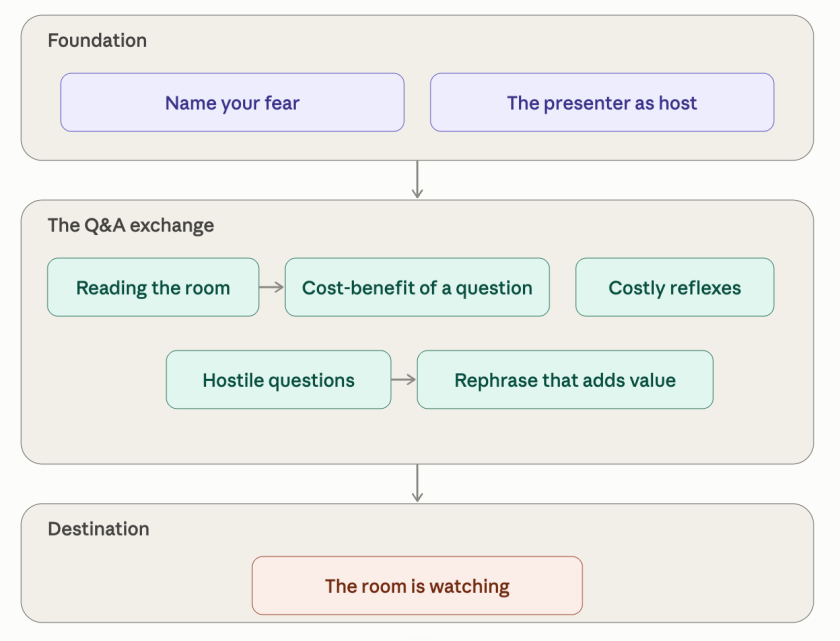
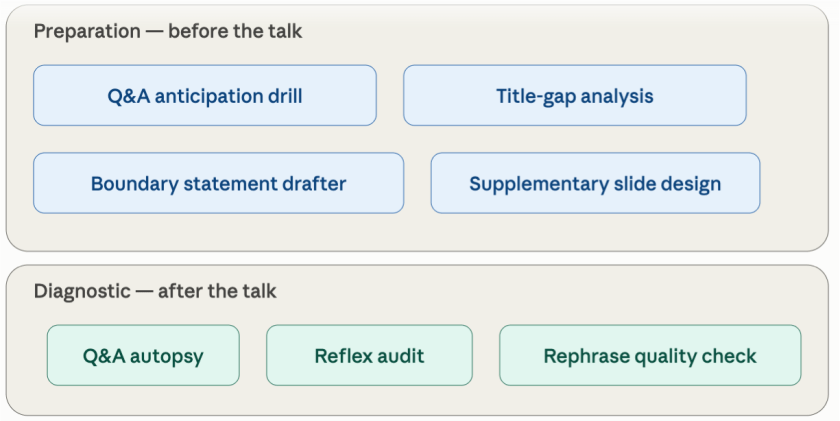
Answerable to a Grant Panel
The grant panel has already read your grant application as well as its evaluation by several reviewers. It wants you to defend your choices, and clarify the concerns that remain. Behind each question is a concern. The effective answers are those that address them. When the underlying concern is unclear, ask clarifying questions. They will help focus your answer. For example, “Your Majesty, are you principally concerned about the ethical issue of freeing a princess without her consent or about the effect of her refusal on feasibility?” Sometimes, you do not know the answer, and it is fine to say you don’t know ‘yet’, and then propose a plan to find out. Grant panels understand uncertainty, but they will not accept evasive answers.
The scroll (a question in ChatGPT) helps you anticipate probable questions. The LiveBook does something more valuable: it questions your answers, exposes their weaknesses, and makes you try again. Merlin’s help is not magical, it is practical. He is not magically revealing the questions the knight will be asked, he is preparing the knight for whatever comes.
With practice, using this tool, you will gain human skills , skills you will use well beyond your grant interview: listening skills, rephrasing skills, hospitable skills to keep you gracious in the face of adversity. But also, analytical skills.
We all have Kings we are answerable to, before the grant, during the grant, and after the grant. Questions are a fact of life, not just scientific questions. Let’s learn how to answer.

